Egypt - Red Sea · Riff
Ras Mohammed / Yolanda Reef
The dive site
Ras Mohammed / Yolanda Reef at a glance
At the southernmost tip of the Sinai Peninsula lie two of the Red Sea’s most famous dive sites: Shark and Yolanda Reef.
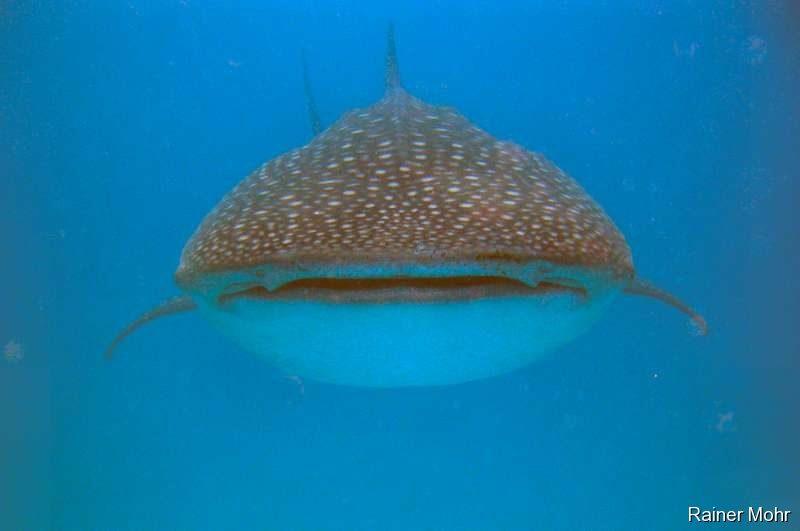
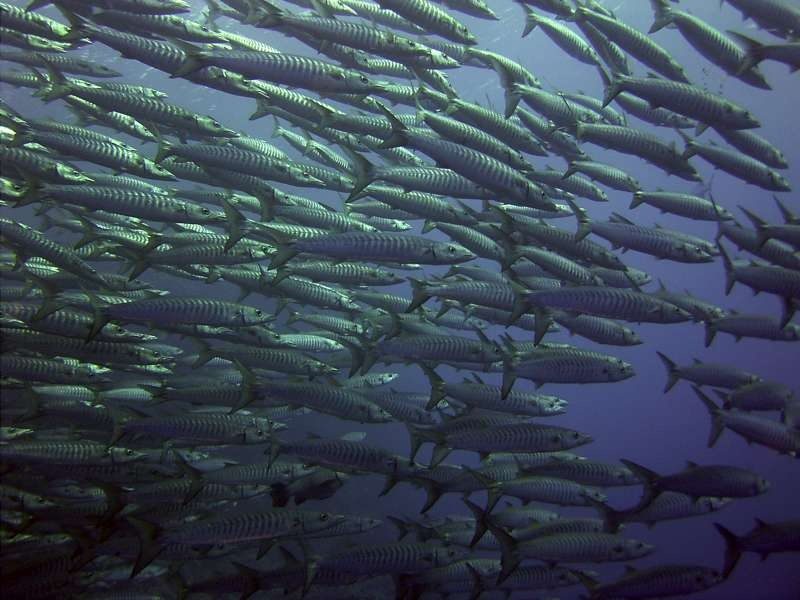
Especially during the summer months, these reefs rightfully earn their place among the top ten best dive sites in the world, as huge schools of snappers, batfish, trevally, barracudas, and blue-line surgeonfish gather here to spawn. With a little luck, you might spot several blacktip sharks (Carcharhinus limbatus) in the midst of the huge barracuda school, and sometimes even a whale shark.
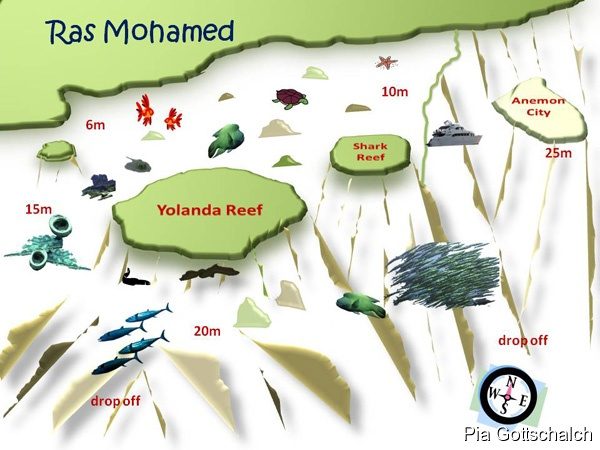
When the current is favorable, the dive usually begins northeast of Shark Reef at Anemone City, a plateau at a depth of 12–20 meters that juts out into the open water like a balcony. Here you’ll find a large number of anemones (Heteractis magnifica and Entacmaea quadricolor), inhabited by countless Red Sea clownfish (Amphiprion bicinctus). At a depth of about 14 meters, there is a vertical metal pole that was erected in the 1970s in memory of a diver who lost his life here.
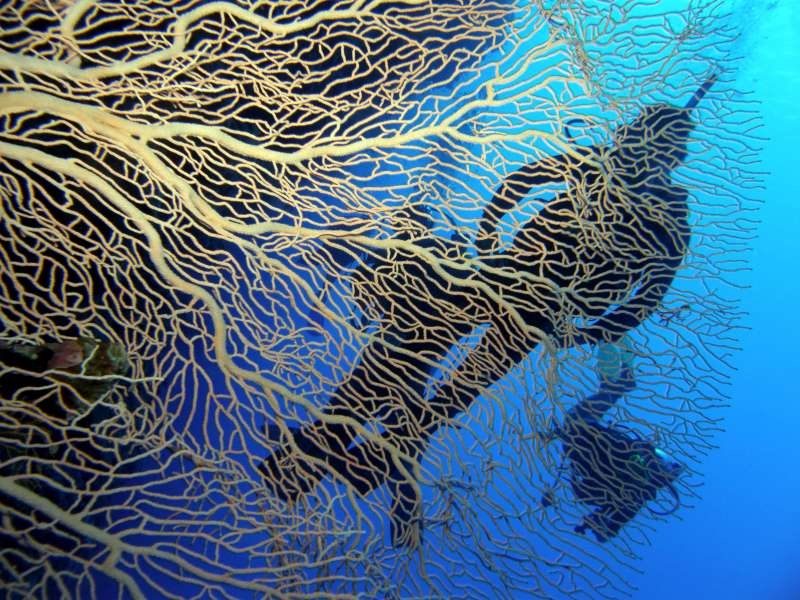
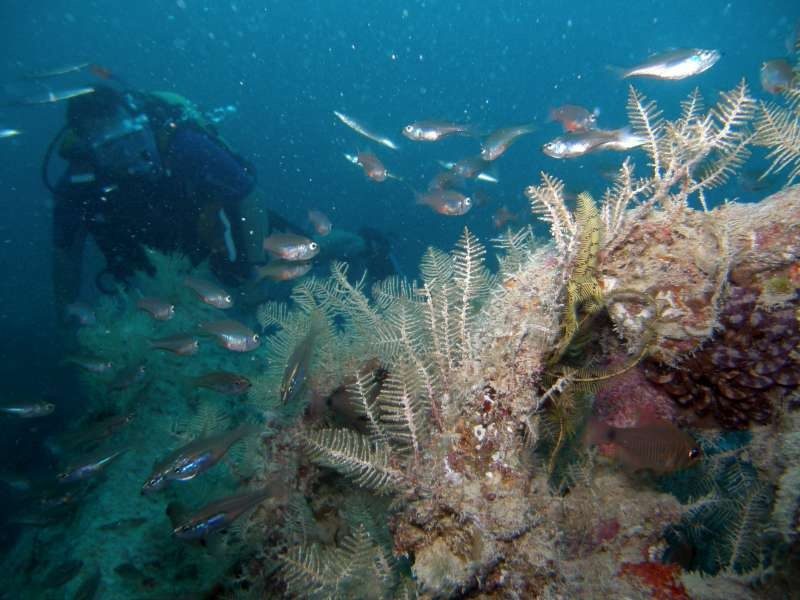
You then spend a few minutes crossing the open water at a depth of about 15 meters and, heading 150 degrees, reach the imposing wall of Shark Reef, which drops vertically to a depth of more than 750 meters. With the reef on your right, you now dive through the gigantic schools of fish in the open water until you finally reach the sandy saddle, which lies funnel-shaped between Shark Reef and Yolanda Reef. Here you’ll often encounter sea turtles and the resident Napoleon wrasse, which frequently follow divers out of curiosity. At a depth of about 14 meters, a huge gorgonian signals the start of Yolanda Reef’s fantastic coral garden. Soft corals in red, white, orange, and crimson stand densely packed on this plateau before it drops off to great depths on the eastern side. You traverse this coral garden—teeming with fish—parallel to the Yolandamain reef to the southern corner, reaching the wreck of the Cypriot merchant ship Yolanda, which ran aground and sank here on its way to Aqaba during the night of April 1–2, 1980. Parts of the ship remained visible above the water for a long time until, after a violent storm in 1987, it finally slid down to greater depths. The bow of the Yolanda was not discovered until 2008 by technical divers on the outer edge of the Yolanda Reef at a depth of 155 meters. The remains of the cargo—consisting of bathtubs, toilet bowls, sinks, and containers—are scattered across the sloping sandy bottom and are now colonized by many soft corals. Many fusiliers, groupers, moray eels, and blue-spotted stingrays can be found among the cargo debris, and a trained eye can also spot true stonefish here.
If you have enough air, the dive usually ends at the small Satellite Reef, which lies directly across from the wreck of the Yolanda. Here you can comfortably complete your safety stop and surface.
Caution: This dive should only be undertaken by somewhat experienced divers, as the current, especially during the summer months, can often be very strong and unpredictable. Due to the reef’s topography, it’s not unusual to encounter currents from the front, back, top, and bottom during a single dive—which, given the immense depth and the fact that you’re diving in open water, requires excellent buoyancy control!
Otherwise, this is a dive that no one is likely to forget anytime soon.
These safari routes call at Ras Mohammed / Yolanda Reef:
Images